The Graveyard Strategy: Why I Failed 48 Times to Win Twice.
When people look at my LinkedIn profile or read the press releases, they see the highlight reel: 500 million users. Top chart positions. Eight-digit profits. Global exits.
What they don't see is the graveyard.
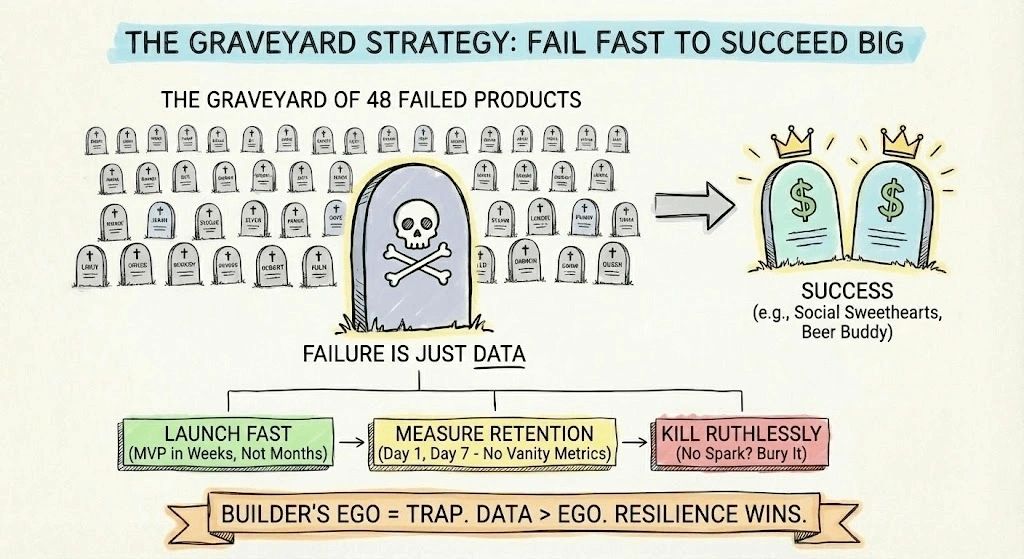
In my 20+ years as a digital builder, I have launched over 50 different products. Most of them? Dead on arrival. Some got a little traction and then faded. Only a handful—like Social Sweethearts and Beer Buddy—became global phenomena.
This isn't a secret I hide. It is the core of my methodology. I call it "The Graveyard Strategy."
The Trap of "Builder’s Ego"
The single biggest mistake I see early-stage founders make is falling in love with their prototype.
I call it "Builder's Ego." Founders spend six, nine, or twelve months perfecting a product in a dark room. They polish the design, they refactor the code, and they debate features without ever showing the product to a single real-world user.
They are terrified that if they launch an imperfect product, they will fail. So they delay.
But here is the harsh truth: The market doesn't care about your effort. It cares about value.
My Methodology: Launch, Measure, Kill.
At Viral Growth Ventures, we operate with a different mindset. We are ruthless with our ideas. We don't try to avoid failure; we try to fail faster.
My process for those 50 products looked like this:
- Launch Fast: We build the MVP (Minimum Viable Product) in weeks. Not months. We strip away every feature that isn't essential to the core value proposition.
- Measure the Pulse: We put it live. We don't look at "vanity metrics" like total downloads. We look at Retention. Do people come back on Day 1? On Day 7?
- Kill Ruthlessly: This is the hardest part. If the retention curve is flat, no amount of marketing budget or design polish will fix it. If the organic spark isn't there, we kill the project immediately.
We bury it in the graveyard and move to the next idea.
Failure is Just Data
I don't view those 48 "failed" projects as a waste of time or money. Each one was a lesson.
- One taught me that users share content to signal identity.
- Another taught me that friction in the signup process kills viral loops.
- Another taught me that timing is often more important than the idea itself.
The two massive successes I had were built on the data collected from the 48 failures.
What I Look For in Founders
When I invest, I am not looking for a founder with a perfect record. A founder who has never failed is a founder who hasn't taken enough risks yet.
I look for resilience. I look for the ability to detach your ego from your product. I want to know: Are you brave enough to kill your darling if the data tells you to?
If you can answer yes, then we speak the same language.
Responsible for the journalistic and editorial content under § 18 (2) MStV: Daniel Minini, VIRAL GROWTH Ventures GmbH, Simplonstraße 14, 10245 Berlin, Germany. [email protected] · Impressum / Legal notice