The Lost Art of Bootstrapping: Profit First, Valuation Later
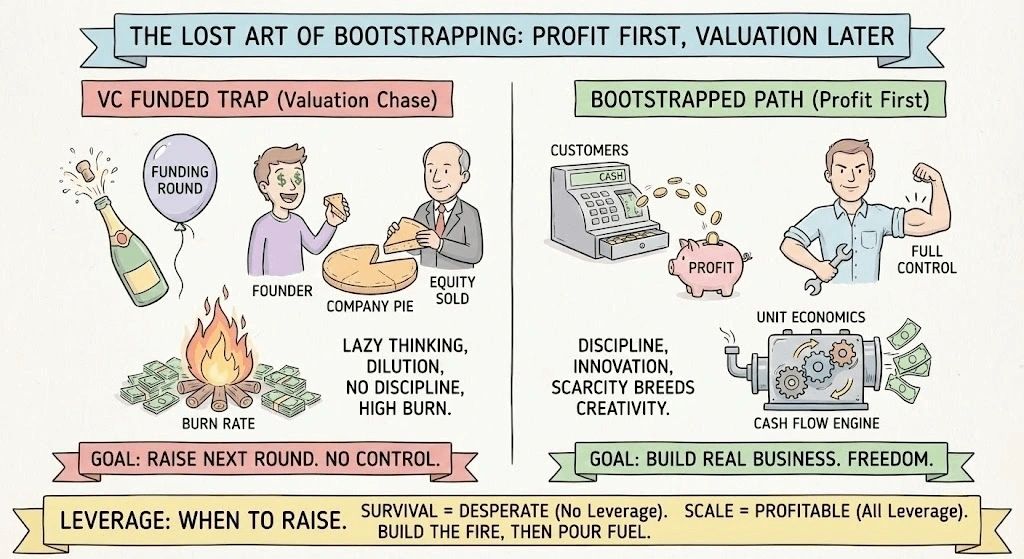
We live in a startup culture that has lost its way.
Open TechCrunch on any given day, and you will see headlines celebrating fundraising rounds as if they were exits. Founders pop champagne when they sell 20% of their company to a VC. They measure success by their valuation, not their profit.
I have a different view. Raising money is not an accomplishment. It is a liability.
I built Social Sweethearts differently. We didn't chase unicorns; we chased customers. We didn't optimize for the next pitch deck; we optimized for unit economics. And because of that, we built a global media asset while maintaining full control.
Here is why I believe bootstrapping is a lost art—and why I look for founders who master it.
Revenue is the Best Funding
The cheapest capital you will ever get doesn't come from an Angel Investor or a VC firm. It comes from your customers.
Revenue is non-dilutive. It doesn't require a board seat. It proves that you are solving a real problem that people are willing to pay for (or that advertisers value).
When we scaled to 500 million users, we financed our growth through our own cash flow. This forced us to be disciplined.
- We couldn't afford to waste money on bad ads.
- We couldn't afford to hire bloated teams.
- We had to be creative because we couldn't be expensive.
The Curse of "Too Much Money"
I see it all the time: Founders raise a massive Seed round and suddenly, they stop thinking. Instead of solving a problem with creativity, they try to solve it with cash.
- Retention is low? Buy more users.
- Product is buggy? Hire more developers.
- No brand awareness? Hire a PR agency.
This is how companies burn through millions without ever finding Product-Market Fit. Having too much capital early on makes you lazy. Scarcity breeds innovation.
Leverage: When to Raise
Now, you might ask: "Daniel, you are an investor now. Why are you telling me not to raise money?"
I am not telling you to never raise money. I am telling you to raise money when you don't need it.
There is a massive difference between raising money to survive and raising money to scale
- If you need my money to keep the lights on next month, you have no leverage. You are desperate.
- If you are profitable (or have strong unit economics) and you want my money to pour fuel on a fire that is already burning, you have all the leverage.
What I Look For
With Viral Growth Ventures, I look for "Real Businesses."
I am not impressed by a slide deck that promises a billion-dollar valuation in 5 years with zero revenue today. I am impressed by a founder who knows their CAC (Customer Acquisition Cost) and LTV (Lifetime Value) down to the cent.
I want to back founders who treat capital with respect. Founders who understand that the goal of a business is to make a profit, not just to raise the next round.
If you are building an engine that generates cash flow, let's talk. I can help you scale it. But if you are building a bonfire to burn cash, I am not your guy.
Responsible for the journalistic and editorial content under § 18 (2) MStV: Daniel Minini, VIRAL GROWTH Ventures GmbH, Simplonstraße 14, 10245 Berlin, Germany. [email protected] · Impressum / Legal notice