Why I Bet Against "Pay-to-Play": The Zero-Ad-Spend Philosophy
In almost every podcast interview I do, eventually, the host leans in and asks the "million-dollar question." They look at my track record—over 500 million unique users across different platforms—and they ask:
"Daniel, what was your marketing budget to achieve that scale?"
The answer usually leads to a moment of silence: Zero.
I didn’t spend millions on Facebook Ads to build Social Sweethearts. We didn’t burn venture capital on influencers to make Beer Buddy chart globally. We grew because we engineered the product to grow itself.
Today, I see a dangerous trend in the startup ecosystem. Too many founders are addicted to "Pay-to-Play." Here is why I bet against that model—and how you can too.
The Paid Marketing Trap
Paid advertising is the most expensive drug in the startup world.
When you launch a product and immediately turn on the ad spend, you are creating a false sense of security. You see numbers going up. You see user acquisition. You see "growth." But often, this artificial traffic masks a fundamental problem: A lack of Product-Market Fit.
If you have to pay someone to use your product, you need to ask yourself a hard question: Is my product solving a big enough problem? Is it triggering the right emotion?
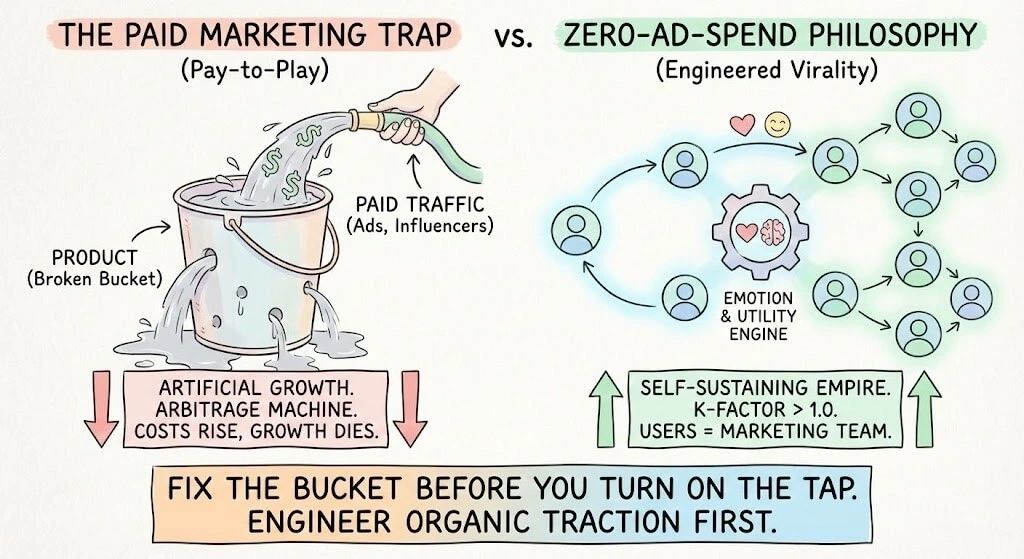
If your growth curve flatlines the moment you stop paying Mark Zuckerberg or Google, you don’t have a business. You have an arbitrage machine. And arbitrage machines always break when the ad costs rise.
My Approach: Engineering Virality
At Viral Growth Ventures, we operate differently. We don't buy attention. We engineer it.
Virality isn't luck. It isn't about hoping a video goes trending. Virality is a mechanism that you build directly into the core of your product. It relies on two non-negotiable pillars:
1. Emotion is the Engine
People do not share logic. They do not share "features." They share emotions.
When we built "Nametests" (Social Sweethearts), we didn't just build quizzes. We tapped into the primal human desire for identity and validation. Users shared their results not because the quiz was technically advanced, but because it said something about them. It triggered curiosity and pride.
With Beer Buddy, we tapped into a different emotion: The Fear of Missing Out (FOMO) and the joy of belonging. The app solves a social friction. You invite friends not to spam them, but because the app becomes useless if your friends aren't on it. That is Utility-Driven Virality.
If your product doesn’t make a user feel something strong enough to tell a friend, no amount of ad spend will save you long-term.
2. Obsessing Over the K-Factor
Most founders show me their CAC (Customer Acquisition Cost) and LTV (Lifetime Value). I ask them about their K-Factor.
The viral coefficient (K-Factor) is the math behind the magic. It measures how many new users each existing user brings in.
- K < 1.0: Your growth will eventually die without paid ads.
- K > 1.0: You have exponential, self-sustaining growth. You have an empire.
The difference between a K-Factor of 0.9 and 1.1 sounds small, but over time, it is the difference between bankruptcy and market dominance.
Fix the Bucket Before You Turn on the Tap
The "Pay-to-Play" mentality leads founders to pour expensive water (paid traffic) into a leaking bucket (low retention, low virality).
My advice to founders—and my strategy as an investor—is simple: Fix the bucket first.
Spend your energy engineering a product loop that turns one user into two. Focus on the psychology of sharing. Build something so good, so useful, or so emotionally resonant that your users become your marketing team.
Once you have organic traction, you can use paid ads to add fuel to the fire. But never use them to start the fire.
Responsible for the journalistic and editorial content under § 18 (2) MStV: Daniel Minini, VIRAL GROWTH Ventures GmbH, Simplonstraße 14, 10245 Berlin, Germany. [email protected] · Impressum / Legal notice